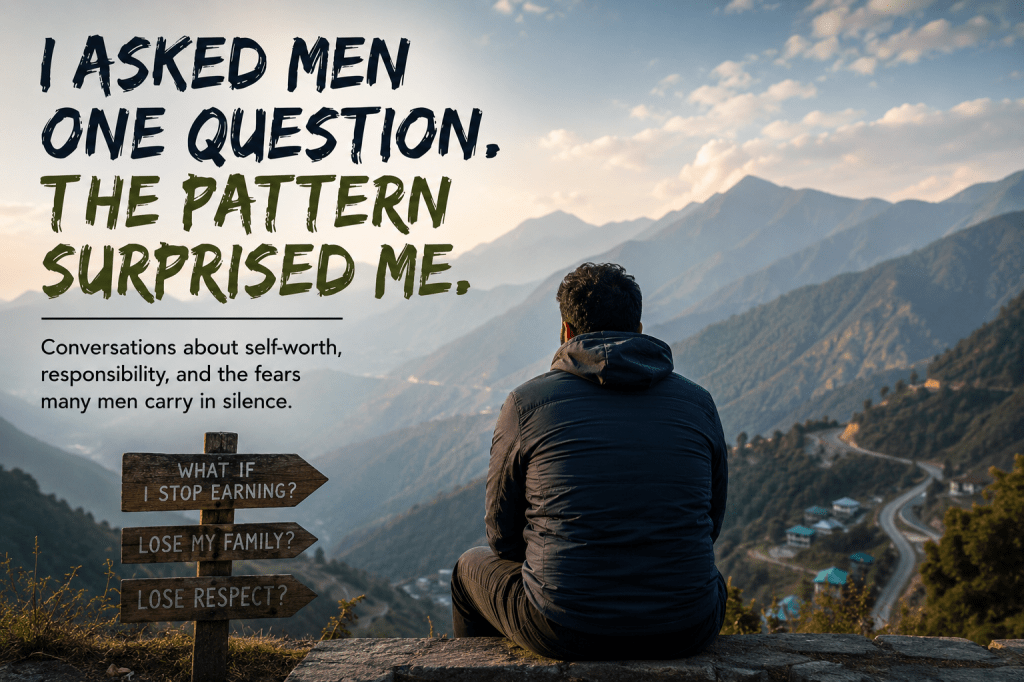
During a recent trip through the mountains of Northeast India, Arunachal Pradesh, I found myself becoming curious about something that had little to do with the landscapes around me.
The mountains were breathtaking. The roads were challenging. The people were warm, welcoming, and generous. Yet somewhere during that journey, my attention shifted from the places I was visiting to the people I was meeting.
More specifically, I became curious about men.
As a counsellor, I often hear conversations about men’s mental health, emotional struggles, relationships, and societal expectations. Most of these discussions happen in cities, workplaces, social media spaces, or therapy rooms. But I wondered what I might learn by stepping outside those environments and simply listening to people living very different lives.
So I decided to ask men a few questions.
Not as part of a formal study.
Not as a survey.
Just as conversations driven by curiosity.
Over the course of my journey, I spoke to men from different professions and age groups. Some were drivers navigating difficult mountain roads. Some worked in hotels. Others were farmers, construction workers, village residents, and government employees. Most were between the ages of 25 and 60.
Many of them did not know me.
Yet almost all of them were willing to talk.
And one particular pattern surprised me.
The First Question
The first question I asked was simple:
“What is your biggest nightmare?”
I expected a wide variety of answers.
After all, these were men from different backgrounds, occupations, experiences, and stages of life.
And there were differences.
Some spoke about losing family.
Some spoke about losing respect.
A few mentioned mistakes from the past that they hoped would never resurface and affect how others viewed them.
But one answer appeared again and again.
In different words.
In different conversations.
From different people.
The answer was:
“What if I stop earning tomorrow?”
Not what if I lose money.
Not what if I lose my savings.
Not what if I cannot buy the things I want.
The fear seemed deeper than that.
The concern was about losing the ability to earn.
What if illness prevented them from working?
What if an accident changed everything?
What if circumstances beyond their control made them unable to provide for themselves or their families?
The more I listened, the more I realized that these men were not only talking about finances.
They were talking about identity.
More Than Money
What struck me most was that nobody spoke about the amount of money they had.
The concern was not centered around wealth.
It was centered around usefulness.
Many of the men seemed to connect earning with something much larger than income.
Respect.
Responsibility.
Acceptance.
Purpose.
Value.
Several wondered what would happen if they could no longer contribute in the way they currently did.
Would people still respect them?
Would they still feel useful?
Would they still be viewed the same way by their families and communities?
As I reflected on these conversations, I found myself thinking that perhaps the fear was not about losing income at all.
Perhaps it was about losing a role.
And for many people, roles become deeply intertwined with identity.
When that happens, a threat to one’s role can feel like a threat to one’s worth.
The Second Question
The second question was even simpler.
“Who do you share this fear with?”
The answer was almost immediate.
“No one.”
A few men mentioned close friends.
One or two said they occasionally spoke about these things with people they trusted.
But the overwhelming majority said they kept these concerns to themselves.
That answer stayed with me.
Not because it was shocking.
In many ways, it was familiar.
Many men grow up learning how to carry responsibility.
Far fewer learn how to talk about the emotional weight that responsibility creates.
The burden itself is often accepted.
Discussing the burden is not.
Stress Behind the Smile
Another interesting observation emerged during these conversations.
Several of the men mentioned taking medication for conditions such as diabetes or blood pressure.
Many acknowledged experiencing stress.
At the same time, they described themselves as capable of handling difficult situations.
And perhaps that makes sense.
Life in challenging environments requires resilience.
When people regularly face difficult terrain, uncertain weather, demanding work conditions, and daily responsibilities, they naturally develop psychological toughness.
But resilience and stress can coexist.
A person can be strong and overwhelmed.
Capable and worried.
Resilient and exhausted.
One does not cancel out the other.
The Men Who Smiled
What made these conversations even more interesting was that almost every person I met smiled often.
They were welcoming.
Warm.
Friendly.
Generous with their time.
Several told me that they had been raised to greet people warmly, to live simply, and to maintain a positive attitude toward life.
This created an interesting contrast.
Many of the men I spoke with carried fears they rarely discussed.
Yet they also appeared genuinely connected to their communities and culture.
Perhaps emotional burden and happiness are not always opposites.
Perhaps people can carry responsibility while still finding joy in everyday life.
Perhaps both can exist at the same time.
Why Their Answers Felt Familiar
After returning home, I found myself reflecting on these conversations more deeply.
Part of the reason they stayed with me was because I recognized something of myself in them.
Years ago, when I was recovering from open-heart surgery, many people told me that life would never be the same.
Some were trying to prepare me.
Others were simply being realistic.
But beneath those conversations was a fear I rarely spoke about.
I was not only worried about my health.
I was worried about how I would be seen.
Would people look at me differently?
Would I become someone others felt sorry for?
Would I be viewed as fragile?
Would I lose the identity I had built around being capable, resilient, and independent?
I did not want to become an object of sympathy.
I wanted to be seen as someone who could navigate adversity and continue moving forward.
That fear became fuel.
I committed myself to rehabilitation.
I took exercise seriously.
I pushed myself further than most people expected.
Eventually, I went on to run half-marathons after surgery.
Not because I wanted to prove something to the world.
But because I wanted to reclaim something for myself.
Looking back, I can see similarities between my own fears and the answers I heard from the men I spoke to.
Many of them were not talking about money alone.
They were talking about identity.
They were talking about value.
They were talking about what happens when life threatens the role through which they have come to understand themselves.
The difference is that I was fortunate.
I had someone with whom I could share those fears.
My wife listened when I struggled.
She supported me when uncertainty felt overwhelming.
More importantly, she often believed in me during moments when I struggled to believe in myself.
Not every man is fortunate enough to have that kind of support.
Perhaps that is why so many answered “no one” when I asked who they shared their burdens with.
A Final Thought
This was not a scientific study.
The sample was small.
The conversations were informal.
No broad conclusions should be drawn from a handful of interviews.
Yet the pattern was difficult to ignore.
Across different professions, ages, and life experiences, I repeatedly heard a similar concern:
“What happens if I can no longer contribute?”
Beneath that question seemed to be another one.
“Will I still be valued?”
Perhaps that is one of the quieter burdens many men carry.
Not simply the responsibility of earning.
But the fear that their worth may be tied to their ability to provide.
The more I reflect on those conversations, the more I believe that the challenge is not responsibility itself.
Most people find meaning in responsibility.
The challenge is carrying responsibility in silence.
Maybe strength is not the absence of fear.
Maybe strength is having a place where fear does not have to be carried alone.
Reflection
If you are a man reading this, what is a fear you rarely talk about?
And if you are not, when was the last time you asked the men in your life how they are really doing?
If this article resonated with you, feel free to share it with someone who might find it meaningful.
You can reach out to me to discuss and get a free discovery call at sanyaldebopom@gmail.com
 Zen Mindfulness
Leave a comment